InfiniBand Cabling for HPC Data Centers: A Complete Guide for New Deployments
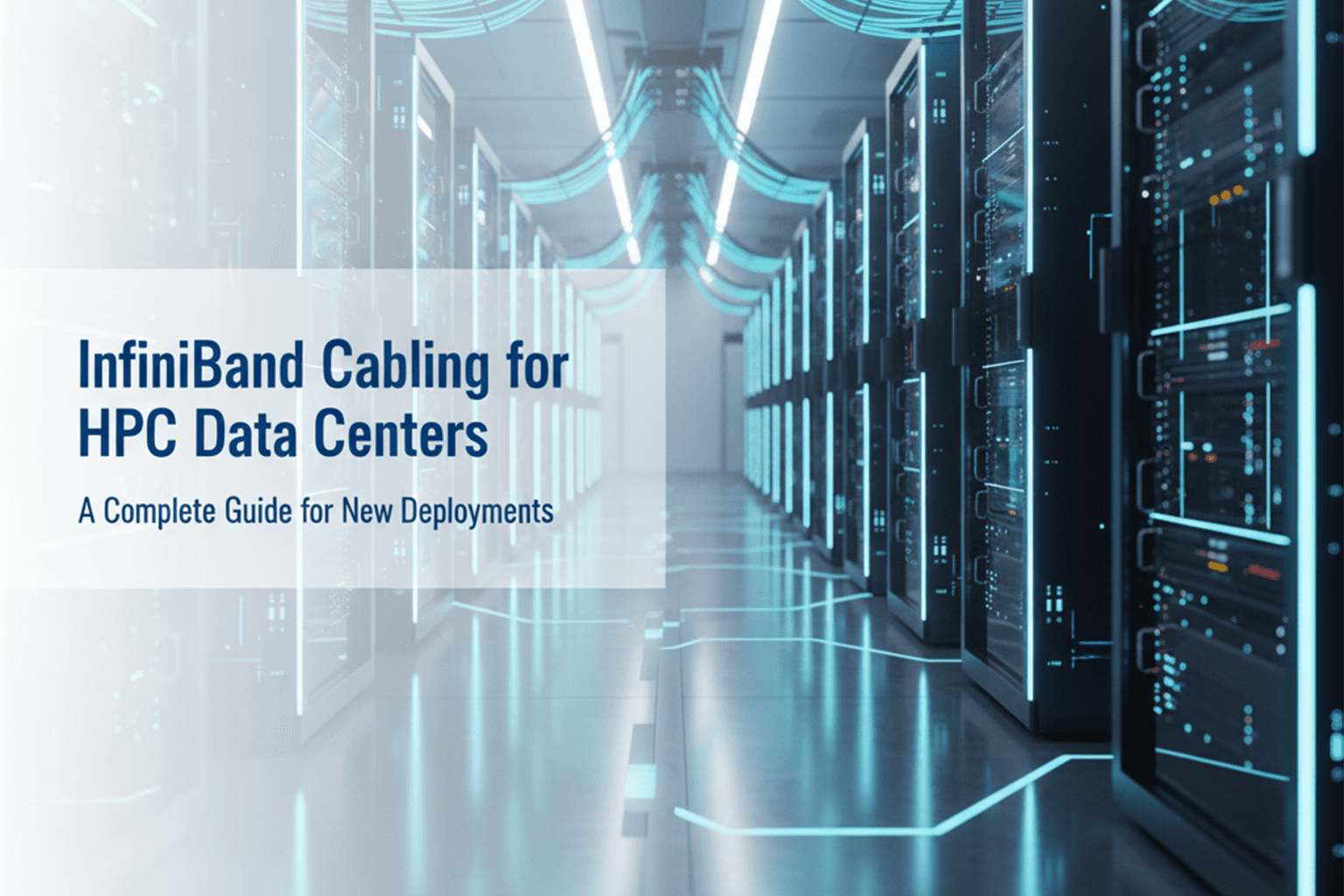
When you’re planning a new high-performance computing (HPC) data center, every infrastructure decision matters. One of the most critical — and sometimes overlooked — is your network cabling. For workloads that require extreme bandwidth, ultra-low latency, and reliable scalability, InfiniBand cabling has become the go-to choice for many modern HPC environments.
If you’re in the early stages of designing or installing a data center, understanding how InfiniBand works and what cabling considerations matter can save you from costly redesigns later.
What Is InfiniBand and Why It’s Relevant for HPC
InfiniBand is a high-speed, low-latency interconnect technology designed to move massive amounts of data between servers, storage, and accelerators like GPUs. Unlike traditional Ethernet, which is built for general networking, InfiniBand is purpose-built for compute-intensive applications such as:
- AI and machine learning clusters
- Scientific simulations
- Weather modeling
- Financial risk analysis
- Big data analytics
With speeds currently ranging from 100 Gbps (HDR) to 400 Gbps (NDR) and roadmaps toward even faster links, InfiniBand enables HPC workloads to scale efficiently without network bottlenecks.
Key Advantages of InfiniBand Cabling in Data Centers
When evaluating your cabling strategy, InfiniBand offers several benefits over alternatives like Ethernet:
- Ultra-Low Latency
InfiniBand can achieve sub-microsecond latency, critical for parallel computing environments where thousands of nodes need to communicate instantly.
- High Bandwidth and Scalability
InfiniBand supports speeds up to 400 Gbps per port with lossless data transfer, making it ideal for data-intensive tasks such as AI training or scientific computing.
- Remote Direct Memory Access (RDMA)
RDMA allows servers to access each other’s memory directly without involving the CPU, reducing overhead and increasing application performance.
- Efficient Topologies
InfiniBand supports fat-tree and Dragonfly+ topologies, making it easier to design scalable networks for large HPC clusters.
Choosing the Right InfiniBand Cabling for Your HPC Setup
Selecting the correct cable type and design is essential for both performance and cost efficiency.
- Direct Attach Copper (DAC) Cables
- Best for short distances (up to ~3–5 meters).
- Cost-effective and easy to deploy.
- Low power consumption.
- Active Optical Cables (AOC)
- Used when you need to connect devices across longer distances (up to 100 meters).
- Lighter and easier to manage than copper.
- Slightly higher cost but essential for large-scale HPC clusters.
- Optical Transceivers with Fiber
- Flexible for long distances and complex routing.
- Scales well in large data center builds.
- Higher initial cost but future-proofs your network.
Pro tip: Plan cable routes early in your data center design. HPC environments are dense — without a clear cabling strategy, airflow and maintenance can become challenging.
Design Considerations Before You Deploy
- Rack Layout & Density – Map cable paths to avoid blocking airflow or service access.
- Port Speeds – Check whether your switches and adapters support HDR (200 Gbps) or NDR (400 Gbps).
- Future Scalability – Design for growth. It’s cheaper to over-provision now than to recable later.
- Signal Integrity – Keep copper runs short; use optical for anything longer to maintain performance.
- Testing & Certification – Ensure your installation follows InfiniBand Trade Association (IBTA) guidelines.
InfiniBand vs. Ethernet for HPC: Quick Comparison
Feature | InfiniBand | Ethernet (Data Center) |
Latency | <1 microsecond | 3–10 microseconds |
Bandwidth | Up to 400 Gbps | Up to 400 Gbps (but higher overhead) |
RDMA Support | Native | RoCE (adds complexity) |
Scalability | Excellent (designed for HPC) | Moderate |
Cost | Higher upfront but optimized for HPC | Lower for general workloads |
Common Mistakes to Avoid
- Mixing incompatible cable types: Always match your switch and HCA (Host Channel Adapter) specifications.
- Ignoring airflow: HPC clusters generate significant heat; poor cable management can lead to thermal issues.
- Underestimating future growth: Upgrading from 100 Gbps to 400 Gbps later can be costly if you choose the wrong cable infrastructure upfront.
- Not labeling cables properly: A small oversight now can cause massive troubleshooting headaches later.
Final Thoughts
If you’re planning or expanding an HPC data center, InfiniBand cabling can provide the backbone your environment needs for high-speed, low-latency performance. While the upfront investment can be higher than standard Ethernet, the long-term scalability and efficiency pay off in demanding compute workloads.
Before you buy, work with a trusted networking partner or cabling specialist who understands HPC environments — proper planning and expert installation will ensure your network performs flawlessly under the heaviest workloads.
 Ready to Upgrade Your Network?
 Ready to Upgrade Your Network?
Let’s talk.

 Or book a free consultation — no strings attached.
We’ll help you understand where your network stands today and how we can take it to the next level